

AI has made finding drug candidates cheap and fast. It has not yet been shown to get medicines to patients sooner.
Views on what AI will do for medicine range widely. Demis Hassabis, chief executive of Google DeepMind and Isomorphic Labs, told 60 Minutes in April 2025 that ending disease is within reach, “maybe within the next decade or so.” Derek Lowe, a drug discovery researcher and author, rebutted him, arguing that machine learning “does not create any new knowledge.” Our view at RTW sits between the two, and a recent experiment by Citrini Research captures it: “AI in biology will progress in a manner that is both alarmingly fast and not fast enough.” This article lays out that view.
Recently, five people at the investment newsletter Citrini Research with no drug development experience set out to see whether AI could design a medicine to neutralize scorpion venom. For about $200,000 and three months, the model designed 211 proteins for outside labs to test. Seventeen latched onto the toxins they were designed to target.1 That is only the first test. No one has yet tested whether the proteins stop the venom from doing harm, and the work, supported by Anthropic, has not been independently reviewed.
At the other end of the funding scale is Isomorphic Labs, a company backed by Google’s parent, Alphabet, that has developed an AI-powered drug discovery engine. It is reportedly raising money at a valuation of about $40 billion.[2] Isomorphic is still in the early stages of the drug discovery process, and as of October 2026, none of its drugs has been tested in people.
Together, the two stories show where AI stands. Discovery, the search for a promising drug candidate, has become cheap and fast, and AI's potential there is large. Development, the years of testing in humans needed to bring a candidate to market, is where AI's impact so far is mostly administrative, and proof of faster trials is still missing. That gap is what biotech investors need to understand.
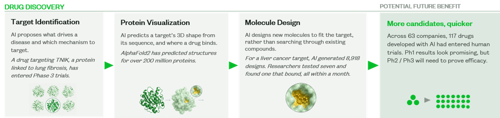

Where can AI help in the near term?
The clearest gains from AI can be seen in more mundane stages of drug development. Rod Wong, MD, RTW’s Managing Partner and Chief Investment Officer, notes that of the roughly seven years a drug spends in trials, two go to administrative and regulatory paperwork and about two for recruiting patients for clinical studies. He calls that “low-hanging fruit, and it’s perfectly suited to the new tools that we have, like AI.”3
The early evidence suggests encouraging progress in some areas, but more work is needed:
· Regulatory reports. In a Pfizer study, blinded expert reviewers rated AI-drafted sections of post-trial reports at about 90 percent of the quality of those written by specialists.4
· Manufacturing operations. Amgen's chief financial officer, Peter Griffith, said on the company's first-quarter 2026 earnings call that AI-enabled automation cut production line clearance time at one manufacturing site from about 30 minutes to about two minutes per batch run.5
· Patient enrollment: Almost 40 percent of clinical trials are terminated because they can’t enroll enough patients.6 Companies like Paradigm Health and Tempus AI are building AI tools to scour hospital electronic medical record systems to match patients with trials.7,8 AI may be able to find patient candidates faster than humans, but patient enrollment still requires patient-provider interaction. Time will tell whether AI can accelerate clinical trials timelines.
The bigger prize is still unproven
About 92 percent of drugs that enter human testing never win approval, so the larger promise of AI is helping scientists choose drugs that are more likely to work.[9] Some of the hardest evidence so far comes from Insilico Medicine, which used AI to identify a potential biological cause of a lung disease and design a drug against it, reaching the point of being ready for formal safety testing in about 18 months.10 That drug, rentosertib, is the first both discovered and designed with AI to reach late-stage trials, with results due by October 2029.11
The track record so far is thin. A 2026 analysis counted 117 AI-developed drugs that had entered human testing. As of December 2025, 60 had finished early trials and 8 had finished mid-stage trials. None has been approved in a major market.12 Another study found that AI-discovered drugs passed early safety trials 80 to 90 percent of the time, well above the industry average, but succeeded about 40 percent of the time in mid-stage trials, roughly the same as drugs discovered the traditional way. Most of those drugs were incremental improvements on known mechanisms of action rather than entirely new ones. The sample was small.13
Speed still needs the right drug
Even AI companies urge caution. Anthropic’s filing to go public on 26 October warns that any drugs from its own research would face the “lengthy, costly, and uncertain development and regulatory pathways characteristic of the life sciences industry.”14 Iker Huerga, chief executive of Pathos AI, put it plainly this month: “Intelligence alone does not bring a therapy to market.”15 Faster, cheaper development creates value only if the drug meets a real medical need.
What does this mean for biotech investors?
Our reading is that AI is delivering lower administrative and manufacturing costs first, with faster trials still to be shown, while proof that it raises the share of drugs that succeed will come from late-stage trials over the next two to three years. For investors, that points to four takeaways:
· Credit the savings now, the discovery edge later. Less paperwork and more efficient manufacturing lower the cost of each drug, and faster trials would add to that. Rod notes that the industry spends about 25 percent of revenue on R&D, so if productivity rises, “you get more revenue for that 25%, so the growth increases.”16
· Treat late-stage readouts as the real evidence. Rentosertib reads out in 2029. Generate Biomedicines is running two late-stage trials in asthma with an AI-engineered antibody in about 1,600 patients, which is due to finish in late 2028 and early 2029. Success would be some of the first evidence that AI-designed improvements translate into patient benefit and commercial success.17
· Be wary of capital running ahead of proof. In October, AstraZeneca agreed to pay insitro $40 million upfront and up to about $1.46 billion more if agreed goals are met,18 and Eli Lilly signed a deal with METiS TechBio worth up to about $1.1 billion.19 In June, Alnylam agreed a deal with Inceptive valued at up to $2 billion.20 Most of that value is paid only on milestones, so investors who pay up front carry the risk themselves.
· Back the asset, not the algorithm. A faster route to a drug that does no better than existing treatments will struggle to earn back its cost. Favor teams that pair AI with disciplined judgment on medical need and on what patients, doctors and insurers will pay for.
The bottom line: AI is already making the administrative and manufacturing parts of drug development faster and cheaper, which is a tailwind for biotech economics. Whether it also produces more drugs that work will be answered by late-stage trials over the next few years. Until then, credit the savings, wait for the data, and pay for proof rather than promise.
Statements reflect RTW’s views and opinions as of the date hereof. All expressions of opinion are subject to change without notice and are not intended to be a forecast of future events or results. This material is for informational purposes only and does not constitute investment advice or a recommendation to buy or sell any security.
1 Citrini Research, “Citrini Therapeutics: We Wanted to Use Claude to Create a New Drug. Here’s What Happened,” 20 October 2026.
2 Allison DeAngelis, “Does Isomorphic Labs have what it takes to revolutionize drugmaking?” STAT+, 19 October 2026. The valuation is press-reported.
3 Rod Wong, op-ed, Fortune, 25 July 2026. [Link to be added.] The RTW Podcast, Season 3, Episode 2, “Innovation is the Best Medicine,” 10 September 2026, rtwfunds.com.
4 Samuelsson J, et al. “A Generative AI Framework for Pharmacokinetic Clinical Study Report Authoring.” Clinical and Translational Science 2026;19(6):e70644.
5 Anthropic, “Early progress on accelerating drug development with Claude,” 27 October 2026. Company-reported results from Enveda’s use of Anthropic’s AI model; Enveda’s technical report is referenced in the post. [Link to Enveda report to be added.]
6 Williams RJ, Tse T, DiPiazza K, Zarin DA. “Terminated Trials in the ClinicalTrials.gov Results Database: Evaluation of Availability of Primary Outcome Data and Reasons for Termination.” PLOS ONE 2015;10(5):e0127242. doi:10.1371/journal.pone.0127242.
7 “Paradigm launches with $203M funding round to expand clinical trial access,” MobiHealthNews, 2023, https://www.mobihealthnews.com/news/paradigm-launches-203m-funding-round-expand-clinical-trial-access; “Paradigm Health raises $78M to revamp clinical research process,” Fierce Biotech, https://www.fiercebiotech.com/cro/paradigm-health-raises-78m-revamp-clinical-research-process-inks-deal-roches-flatiron.
8 Tempus AI, “Tempus Announces Acquisition of Deep 6 AI,” press release, 11 March 2025, https://www.tempus.com/news/pr/tempus-announces-acquisition-of-deep-6-ai/.
9 Informa Pharma Intelligence, BIO and QLS Advisors, “Clinical Development Success Rates and Contributing Factors 2011–2020,” 2021. The study found that 7.9% of programs entering Phase I reached U.S. approval; the 92 percent failure rate is the complement.
10 Ren F, et al. “A small-molecule TNIK inhibitor targets fibrosis in preclinical and clinical models.” Nature Biotechnology 2025;43(1):63-75.
11 ClinicalTrials.gov, NCT07687459, retrieved 27 October 2026.
12 Haque W, et al. “Clinical-stage AI-enabled therapeutic assets: an industry-wide analysis of scale, clinical progression, and company characteristics.” Journal of Clinical Oncology 2026;44(16_suppl):11072. ASCO 2026 conference abstract; data as of 1 December 2025. [Public source confirming no approvals to be added.]
13 Jayatunga MKP, et al. “How successful are AI-discovered drugs in clinical trials?” Drug Discovery Today 2024;29(6):104009.
14 Anthropic, PBC, Form S-1 registration statement, filed 26 October 2026.
15 Pathos AI, Pathos AI Announces Strategic Collaborations with Bristol Myers Squibb and Tempus AI to Advance AI-Driven Drug Development Beginning with Alzheimer’s Disease and Other Neurological Conditions | Tempus AI, Inc., 23 October 2026.
16 The RTW Podcast, Season 2, Episode 4, “Biotech’s Next Era: Innovation and Commercialization,” 12 January 2026, rtwfunds.com.
17 ClinicalTrials.gov, NCT07276724 and NCT07359846 (SOLAIRIA-1 and SOLAIRIA-2), retrieved 28 October 2026; Generate Biomedicines, second quarter 2026 financial results and business update, 6 August 2026. Company-reported.
18 AstraZeneca, “AstraZeneca announces new strategic collaboration with insitro to use advanced AI systems to develop transformative therapeutics for difficult to treat cardiometabolic diseases,” press release, 15 October 2026; insitro, “insitro Announces a Strategic Collaboration with AstraZeneca for AI-enabled Discovery of Novel Therapeutics for MASH and Cardiomyopathies,” press release, 15 October 2026. The $40 million upfront and approximately $1.46 billion milestone figures are stated in insitro’s release.
19 METiS TechBio, “METiS TechBio Announces Strategic Collaboration with Lilly to Advance Next-Generation Tissue-Specific LNP Delivery Technologies,” press release, 19 October 2026. [Confirm link.]
20 Alnylam Pharmaceuticals, “Alnylam and Inceptive Form Strategic AI Collaboration to Accelerate the Discovery of RNAi Therapeutics,” press release, 3 June 2026.

